
FATS Friend or Foe?
The Common Perceptions
Fats have often been viewed negatively due to their association with rising rates of obesity and heart disease, leading many consumers to choose low-fat and fat-free products. More recently, awareness has grown around the distinction between healthy and unhealthy fats. However, there is still considerable confusion about which types of fats are beneficial and how much should be consumed for good health.
Digestion of Fats
Chemically, fats are a combination of glycerin and one or more fatty acids.
For fats to be digested they must be split into glycerin and the atomic elements of the fatty acids. Bile from the gall bladder and lipase, an enzyme from the pancreas, carry out this process known as emulsification. However, overheated fats cannot be emulsified. As a result, overheated fats and foods cooked in them cannot be properly digested. They not only lose nutritional value, but their end products clog the colon and cause constipation. In contrast, unheated and unprocessed fats are quickly and completely emulsified by the body.
Beneficial Fats
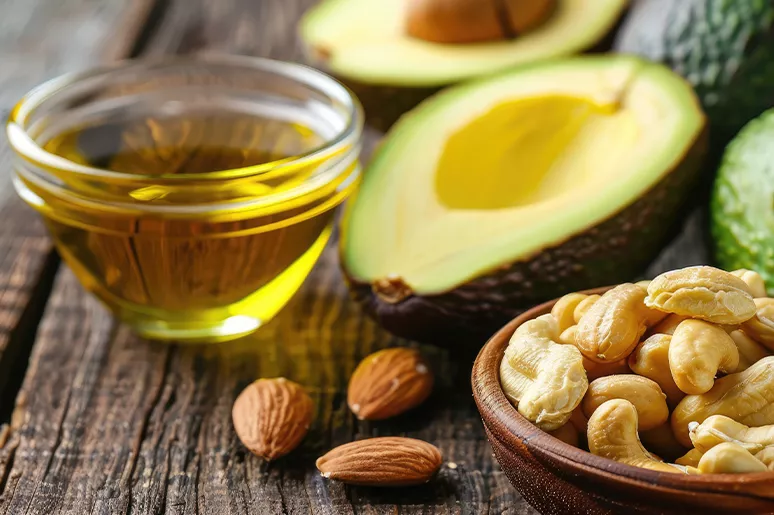
Dr Walker comments, “Cold pressed oils are the only oils which are definitely beneficial and constructive. Avocados are the very finest source of fat that we can put into our body. All nuts contain good and a plentiful volume of fats, while all vegetables are imbued with fats in varying degrees.”
Types of Fats
Fats can be broadly divided into two categories: Saturated & Unsaturated.
Unsaturated fats are thin oils found in fruits, nuts, seeds and grains. These include avocado, olive, walnut, almond, sunflower, sesame, rice bran, safflower, mustard, rapeseed, peanut, and corn oils.
Saturated fats are thicker and heavier and come from animal sources and coconut. Examples include butter, cream, cheese, clarified butter (ghee), full-fat dairy, lard, coconut oil and palm oil.
Cholesterol
Dr Walker states, “Cholesterol is the unnecessary nightmare of far too many people who are fearful that a mouthful of fat will cause the rapid degeneration of their blood vessels and what not. As a matter of fact, the body needs cholesterol.”
Cholesterol is a waxy, fat-like substance produced mainly by the liver and intestines from fats, sugars, and proteins. Because cholesterol cannot travel through the blood on its own, the liver packages it with other fats into tiny carriers called lipoproteins, such as LDL and HDL. LDL helps build cell walls and hormones, but too much of it can form plaque in blood vessels and arteries, increasing the risk of stroke and heart attack; this is why it is called “bad” cholesterol. HDL, by contrast, removes excess cholesterol from the blood and carries it back to the liver for elimination; this is why it is called “good” cholesterol. People whose diets are rich in unheated, unsaturated fats and fresh foods are less likely to develop cholesterol problems.
While all foods contain both these fats, the proportion of saturated to unsaturated fats vary widely.
There are plenty of foods in which saturated fats are low while unsaturated fats are high.
The best is to pivot towards plant-based foods such as vegetables, fruits, seeds, nuts and cold pressed oils, and avoid or reduce animal foods and manufactured fats. For non-vegetarians, it is much better to occasionally eat free-range poultry or fish with fins and scales, omitting scavenger fish and crustaceans. For guidance, here is a list of foods in which the unsaturated fats exceed the saturated fats. For example, Avocado contains 3½ times more unsaturated fats than saturated fats.
Almonds 11, Brazil Nuts 4, Black Walnuts 15, Chickpea 10, Corn Meal 7 ½, Eggs 2, English Walnuts 13, Hazel Nuts 18, Hickory Nuts 11, Millet 2, Oats 3 ½, Olive Oil 8, Olives 8, Pistachio 8 ½, Pumpkin Seed 4 ½, Pecans 12, Rice 4 ½, Safflower Oil 11, Sesame Seed 7 ½, Sunflower Oil 8, Whole Wheat 5.
Energy
Fats provide 125% more energy than carbohydrates (sugars) or proteins. However, their release of energy is slower as compared to carbohydrates.
Vitamin Balance
Vitamins A, D, E and K are fat-soluble, meaning that consuming the right types of fats is important for supporting their absorption and helping prevent deficiencies. Unlike water-soluble vitamins, these nutrients can be stored in the liver and body fat for use when needed.
Various Functions
Fats form the protective outer walls of every cell and regulate the movement of substances in and out of them. Fats also form protective sheaths around nerves, allowing electrical signals to travel quickly and safely. Fat tissue cushions vital organs, protecting them from physical shock.
Lubricates Joints
One of the functions of fats is to lubricate the joints of the body. With the rise in consumption of foods cooked in fats and hot oils, painful inflammation of the joints has increased. The ailment known as Bursitis occurs due to the drying up of the synovial fluid, the lubricant that keeps joints supple. Cold pressed oils or avocado taken daily provides the best lubricant for the joints.
Anil Kapur a student of Dr. Walker provides a corollary on heated fats, “When a car is serviced, its engine oil is changed because heat from friction causes it to lose fluidity. In the body, we do the opposite, fresh oil is heated, causing it to lose its ability to lubricate and perform vital functions, and then wonder why we feel pain and discomfort?”
Constipation
Constipation is another consequence of eating foods cooked in excessively heated fats and oils.
Natural fats help lubricate the intestinal tract in particular and the entire body in general. Without enough lubricating fat, the body may have difficulty expelling feces and waste.
Trans Fats
Trans fats are created by adding hydrogen to liquid oils to make them more solid and extend shelf life, though small amounts also occur naturally in meat and dairy. They raise harmful LDL cholesterol, lower beneficial HDL cholesterol, and increase the risk of heart disease and stroke.Common sources include margarine, vegetable shortening, vanaspati ghee, deep-fried foods, packaged baked goods, and non-dairy creamers, so they are best avoided.
Fried Foods
Fried foods can be difficult to digest and offer less nutritional value because high heat damages fats and oils. When oils and fats are heated, temperatures often reach 350–450°F. For example, olive oil used for frying can quickly reach about 350°F, where it begins to decompose; the same applies to many other oils. Dr Walker comments, “Once you know that excessive heat completely destroys the value of any fat for nutritional purposes, you may want to do what we do, and that is, to diligently and assiduously avoid eating any food which has been fried.”
For cooking, saturated fats such as butter, ghee, and coconut oil are preferable as they tolerate heat better and break down less readily than thinner oils.
Give It A Thought
Anil Kapur reflects: “Hot water is enough to clean a bowl of salad made with cold-pressed oil or avocado. In contrast, a pan in which oil has been heated must be scrubbed with detergent. Even after thorough washing, if hot water is poured into the pan, oil droplets may appear floating on the surface a short while later.
In a kitchen exhaust, oil collects and thickens to an extent that cleaning it often requires a chemical or petroleum-based product. The same happens with cooked fats that enter the body. Once heated, these fats cannot be properly emulsified or broken down and therefore remain indigestible. This matter may be carried by the blood to the liver and adversely affect its health. The liver is much like a sponge, when oil gets into one, a great deal of detergent is needed to clean it. Keep this in mind when eating foods cooked in fats and oils.”
Suggestions
- Taking 1 or 2 tablespoons of cold-pressed oil daily is very beneficial and may be added to salads.
- Eat ripe, fresh avocado whenever available; it can also be used in place of oils.
- Nuts, seeds, and eggs contain both fats and proteins and are best eaten unheated.
- Avoid deep-fried foods, as they seriously harm the body.
- Steaming is the best way to cook; cold-pressed oils can be added at serving time.